HDB Photos Circa 1975

I just started working on a side project that led me to a book about public housing in Singapore written in1975.  With more than 80% of Singaporeans living in public housing, or Housing Development Board (HDB) flats, these buildings have more than shaped the landscape of Singapore, they have also shaped many aspects of Singaporean’s lives, from shopping habits, to socialization patterns, to commuting patterns, even how children play.  I can’t wait to share more on this project in a few months, but for now I will just say it has facilitated many of interesting conversations about a topic I am very passionate about: housing.

Yesterday evening though I spent some time looking through this book with friends.  As they reminisced about growing up in similar flats,they reminded me that their is much more to Singapore’s housing story than simply improving the physical conditions of housing. Instead the story must be about those that were housed, about how they live and how their lives were changed by HDB flats. For now though enjoy these HDB photos circa 1975.

- Melissa

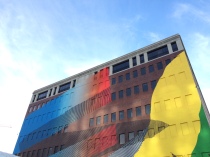
Queenstown Neighborhood VI,which has 4,500 units

Toa Payoh New Town

Queenstown Neighborhood IV with 5,000 housing units and light industry.

“Typical” living rooms in a three room (2 bedroom + living room) flat and a five room (4 bedrooms + living room) flat.

All images are from “Public Housing in Singapore a Multi-Displinary Study” Edited by Stephen H.K. Yeh, Published by Singapore University Press for the Housing and Development Board. 1975.

City Beautiful: A Run in Singapore

I also am not a real “runner.” Last year though I decided to take up running as a way to clear my head during my last few months of grad school and to explore Brooklyn before I moved.  Now that I have relocated, I enjoy running as a way to explore more of my neighborhood in Singapore, especially after a long day in an office. Many people though think that Singapore’s hot and humid climate would make running here miserable, but I have really come to enjoy my shaded evening runs along a few canals.

Unlike Amy’s running experiences in Dar es Salaam, I must admit that I am quite spoiled by Singapore’s extensively developed park system, complete with a Park Connector Network of running and biking trails.  The National Parks Board is even working towards completely connecting these trails so that one day I (in theory) will be able to run around the entire island. Even with all of this lovely infrastructure though I must admit I am slightly jealous of the ad hoc sites throughout Amy’s run on the Swahili coast.  My favorite run thus far is along the Ulu Pandan Canal because it passes through a variety of different Singaporean spaces, including the Clementi HDB Housing estate, landed houses, a set of community gardens, a few patches of Singapore that still feel “natural,” while also passing under MRT tracks, elevated highways, and an old Railway.  Even in this humidity, the shaded trail at sunset and this diversity of spaces make for a pleasant jog. Enjoy.

- Melissa

Ulu Pandan Canal

A glimpse of some community garden plots.

Someone fishing in the canal Sunday evening.

Part of the extensive drainage system that feeds into the canal.

Running under the old railway tracks.

The MRT tracks on the left and the highway on the right.

A giant Buddha in the background.

Sunset on Sunday.

All photos were taken by the author, some may have also appeared on instagram.

City Beautiful: Scenes from a Sunset Run on the Swahili Coast

Though I do technically run, I don’t consider myself a “runner.” I never really enjoyed it and my short, stumpy body isn’t remotely built for it either (anyone that reads my posts will be familiar with my love of the bicycle, however). Living in Dar es Salaam of all places is slowly changing that – even though there aren’t what you would call “sidewalks” or “parks” to really facilitate physical activity, my runs along the narrow and at times harrowing streets on the Indian Ocean have been at once hilarious, beautiful, uplifting and, dare I say, enjoyable.

Ocean Road near my office in the city center is virtually undeveloped, and a precious open space that is lively and active as the sun sets – teenage guys play soccer, partners do calisthenics and running drills in the sand, loners shadow box, people sit on the eroding sea wall and watch the waves, ladies and gentlemen sell coconuts and ice cream. It’s not just the beautiful scenery that makes running less painful – it’s the people too. The coconut vendors cheer me on with chats of “Mazoezi, sista!” (“Exercise, sister!”), “Yes! Yes!”, and “Safi sana!” (“Very fresh!”). Passers-by also dole out big smiles and thumb’s ups that are just bursting with encouragement – perhaps these little gestures are meant to keep a little runner going who looks positively bedraggled, beet red and broken down. But in the moment I will allow myself to feel like one of those tall, lithe, cheetah-people that run marathons in like five minutes, as I plod along the beach basking in its lovely friendliness.

Below are a few scenes snapped while pretending to check my running time on my phone. It’s high tide and the sun was setting. Enjoy.

~Amy

Nightly football game:

Contemplation 1:

Kids playing in the waves and hamming it up:

Contemplation 2:

Tree, precariously close to eroding into the ocean but hanging in there:

All photos by author, and appear as they were taken. That is to say, un-Instagramed.

Diary from Mumbai: Part I

IMG_0131

By: Ariana K MacPherson

**Cross-posted from the SDI blog**

Mumbai has a constant buzz. That is the best way to put it. The city is always moving, coming and going in all directions And full of light. I arrived in Mumbai three days ago, and immediately was taken aback by the vibrancy of it. Even as I made my way from the bustling airport at 1am to my hotel, taxi cabs lined the streets and pavement dwellers sit in front of their tin shacks, eating around fires.

I am here to visit the Indian SDI alliance, an impressive trio of organizations consisting of Mahila Milan (the women’s savings collectives, which are federated citywide as well as nationwide), the National Slum Dwellers Federation (a network of male-dominated slum dweller federations operating at the same scale as MM) and the support NGO, SPARC. I have heard tales of the dynamism, innovation and success of MM-SPARC-NSDF, but truly there is nothing like seeing it for yourself. The same goes for Mumbai, for Dharavi, for all of it: you can read all the books, see the movies, read the newspaper and taste the food abroad, but there is nothing like coming face-to-face with the life of the city, of the people, to make you really understand.

Yesterday was my first day in the field. Alongside a colleague from SPARC, I visited three of Alliance’s projects in Greater Mumbai. First we stopped at a housing project in Dharavi called Rajiv Indira, designed by the women of Mahila Milan. The building is light and airy, with children playing and riding small bicycles in the wide corridor. On the ground floor there is an open courtyard, where women congregate with their kids, chatting about the day. All but the top two floors of the building have been constructed with 14-foot ceilings so that families can build a mezzanine floor to maximize the 225 sq ft space.

The women make this happen through financing from various sources, but savings is a big part of it. Not only does money collected through daily savings go towards financing the actual housing projects, but it also serves as a means to organize, mobilize and unify the group around a common vision for the community. Even after moving into the building, the women continue to save in order to pay for maintenance and further improvements to their homes. It is not a project-based activity, but instead becomes the very core of their activities.

I have read so much about Dharavi. How residential and commercial uses co-exist. How many millions of dollars are generated there. How high the population density is. How poor some of the living conditions. How vibrant, and dynamic a place it is. But again, nothing compares to reality. It is not simply a slum – Dharavi is a town. The true essence of an informal city, existing right in the centre of the formal city, feeding into it minute to minute and day by day. We make our way to a community toilet project, turning off the main (4-lane) road and onto a crowded, winding side street. We pass a Hindu temple, painted bright with garlands and incense adorning the entrance, and are shaded by green canopies of tall, old trees. A white cow passes us on the right.

We arrive at the community toilet and it is bright, airy and clean. My colleague explains that it is used by 226 families (roughly 1,300 people), each of whom pays 20 rupees per month (about USD .40). Others pay 2 rupees per use. There is a caretaker who looks after the facility daily, closing it only from 1am – 5am. He has a room upstairs that he shares with his family, and there is a lovely roof terrace with a mosaic tiled floor that can be used by the 226 families for community events and meetings. There are basically two other options for toilets in Dharavi: 1) shit wherever you can find a hole, which often means holding it in until it is safe (especially for women), and of course causes numerous health risks; or 2) use one of the government-provided communal toilets, which tend not to be well looked after, and are often dark, smelly and unpleasant to use. By making this a community project, it has kept the toilet clean and pleasant to use. One of us even stopped to pay the 2 rupees to use it during our visit!

The last site we visit is a housing project called Milan Nagar, also designed by the women of Mahila Milan, located in Mankhurd settlement quite a ways from the centre of Mumbai. This group of women were pavement dwellers, perhaps Mumbai’s poorest population, and some of Mahila Milan’s oldest members. They lived in shacks along the sidewalks, crowding the streets near Bombay Central station. The women tell us that one of the biggest differences in their lives today is that they are no longer called “pavement dwellers” – that they are respected by others because they now live in formal housing. But pavement dwellers chose their spots on the streets to be close to economic activity, and the women say this is one of the challenges of their new home. It is further to go to work, and they cannot come home between jobs to spend time with their children. There are three different design options within the building, each one consisting of a mezzanine floor like the building in Dharavi. The homes are modest but beautifully maintained, with sparkling pots and pans and spotless floors. Children play in the hallways, and music pours down the stairwells as a family upstairs prepares for an upcoming wedding.

After spending the afternoon at the SPARC offices, housed in a beautiful old municipal building in South Bombay, another colleague whisks me off to a Mahila Milan function in honor of a Hindu holiday celebrating the beginning of spring. This is the real thing. There are hundreds of women, all dressed in colorful saris and their best gold jewelry. We are asked to come on stage, and are honored with flowers, and decorated with saffron and turmeric on our foreheads. We eat sesame sweets and listen to the women speak about their daily realities, from the importance of daily savings to their struggles with crime. Before the close of the evening, traditional music comes on and the women begin to dance. We are drawn into the crowd and a young women smiles and grabs my hand. We dance together, laughing and I doing my best to imitate her every move. It is infectious – the vibrant soul of this community. Empowered and real, dancing under the scaffolding of 900 new homes.

Happy Chinese New Year from Singapore!

As an foreigner celebrating my first CNY in Asia I must admit I spent most of my holiday weekend avoiding very crowded public spaces such as Chinatown and  the malls filled with people preparing for reunion dinners.  Therefore I have few urbanist related observations about the physical aspects of Singapore during this festive time. I did however enjoy many meals and gatherings with dear friends and their families, from Singapore and abroad, over the weekend. Being able to spend time with these people reminds me of one of my favorite aspects of being a city dweller – meeting and befriending people from all over the world. It is cities such as Singapore and New York, which function as hubs for so many industries and knowledge centers, that we are more likely to interact and meet people from across the world. While I have met many fascinating people in rural towns in Latin America, Africa and Asia, the diversity of my friends in these towns can never compare to the networks I have been blessed with in New York and Singapore.

Therefore while my first CNY in Asia may have been mostly spent in private spaces instead of exploring how the city celebrates in public, the simple act of sharing a few meals with people allowed me to remember why I love living in cities. In the end it really is the people that draw us to cities.

- Melissa

20120126-180636.jpgBraised Duck at a Lunar New Year Lunch with an Indonesian Family

20120126-180703.jpgYu sheng, meaning “prosperity toss,” a relatively new Singaporean CNY traditional dish which everyone tosses together before serving.

20120126-180719.jpgSpekkoek, a descendent Indonesian layered cake that a friend brought back from Jakarta.

20120126-180738.jpgAn early CNY meal with National University of Singapore colleagues and researchers from Europe, Australia and Hong Kong after an international workshop.

20120126-182213.jpgWatching a lion dance at the Singapore Art Museum.

For photos of Singaporeans celebrating the Year of the Dragon outside of their homes, especially in Chinatown, CNNgo has a beautiful sideshow of the festivities.

All photos are by the author, the art work featured at the beginning is from the Singapore Art Museums Signature Arts Prize.

Negotiating the Right to Stay: A Community-Led Process in Old Fadama

Aside

**Cross-posted from the Shack/Slum Dwellers International blog**

The air in Accra is humid and full of dust. After spending days inside heavily air-conditioned conference centers and nearby hotels, you start to forget the realities of city life.  Luckily, I got a reminder.

I spent my last day in Accra in the centrally located settlement of Old Fadama. Old Fadama is an informal settlement occupying 31.3 hectares of land along the Odaw River and Korle Lagoon in central Accra. Established in 1981, its population of roughly 80,000 inhabitants is made up of traders and migrants from across Ghana as well as other neighboring West African countries.

The community has resisted threats of eviction for nearly a decade through use of tools such as enumerations, mapping and lengthy negotiations with the Accra Municipal Authority (AMA).  Most recently, the Ghana Federation of the Urban Poor (GAFUP) and the Old Fadama Development Association (OFADA) have been in negotiation with the AMA around the clearing of structures from land around the Korle Lagoon in preparation for a large-scale de-silting project, funded by the Netherlands Government. Korle Lagoon has experienced decades of pollution serving as the main runoff for the entire city of Accra and its shores as dumping ground for much the city’s solid waste.

Initially, the AMA requested that 100 feet of land be cleared to make way for the project. GAFUP and OFADA members estimated that clearance of 100 feet would mean demolition of nearly 3,000 structures and eviction for roughly 7,000 inhabitants. They quickly entered into negotiations, proposing that the amount of land be reduced to 50 feet. Immediately, the community went to work enumerating the 50-foot area. Reducing the amount of cleared land to 50 feet meant a reduction to 1,192 residential and commercial structures and 3,000 people. Still not ideal, but certainly a marked difference.

Armed with their enumeration data, GAFUP and OFADA met with city authorities at the AMA and succeded in negotiating for their proposed 50-foot area instead of original 100 feet, reducing the number of people affected significantly.

The next step was a community led demolition and realignment of structures on right of access identified and negotiated jointly between the residents and the City Authorities. Members of GAFUP and OFADA led this process, first meeting with community members to explain the demolition and relocation process.

A federation member in Old Fadama

Getting the wider community on board has been key to the success of the process. I spoke with a woman whose structure is waiting to be demolished. She has been a member of GAFUP since 2008. However, she says she doesn’t know where she will go when her structure is demolished – that she will simply have to find a piece of vacant land and erect her structure there. Sadly, this means she will likely have to live on the edges of Old Fadama, where the dirt paths are riddled with rubbish and the harmattan hits harder against the shack walls.

Despite these inevitable hardships characteristic of any relocation, resettlement of displaced peoples to other locations within Old Fadama is a success story in and of itself. Most tales of relocation involve displacement to many kilometers outside of the city, far from social ties, employment, and opportunity. Thanks to the successful negotiations of GAFUP, OFADA and People’s Dialogue Ghana, this is not the case in Old Fadama.

In our discussions with GAFUP and OFADA, it became clear that a waste management plan will be crucial to the success of the imminent de-silting project in order to prevent continued pollution of the lagoon. This is a key time for GAFUP, OFADA and People’s Dialogue to put their negotiation skills to use. Waste remains a major issue in greater Accra, and the creation of a community-led waste management program for Old Fadama could serve as a key tool for income generation, community upgrading and negotiation with local authorities around the community’s capacity to engage in the upgrading process.

Farouk Braimah, director of the Ghanaian support NGO People’s Dialogue, stresses, “This whole exercise promises huge benefits and leverages. We anticipate capitalizing on this exercise to strengthen our hitherto weak relationship with the city authorities of Accra and to feed into [other projects] in Accra and Ashaiman.”

Bearing witness to the reality and determination of this community, alongside some of its key leaders, was certainly an experience no conference could compete with.

- Ariana

For more photographs of Old Fadama, check out SDI’s albums on Flickr and Facebook

Follow SDI on Twitter @sdinet